Mobile App Localization: A Glance of Global Growth
Mobile app localization is more than translated UI strings - it's app store metadata, continuous workflows, and format changes. See what real teams did, and how to start.
Mobile apps generated roughly $530 billion in 2024 and were on track for around $585 billion in 2025 - and an increasing share of that growth sits outside English-speaking markets. Most developers still treat localization as a translation task that happens once, near the end of a release, instead of a growth lever that touches app store listings, notifications, and release workflow. This article covers what mobile app localization actually needs to cover, what happened when a small team localized from day one, and a practical process for doing it without turning every release into a bottleneck.
What Is Mobile App Localization, and Why It Goes Beyond Translation?
Mobile app localization means adapting an app’s UI text, date/currency/unit formats, push notifications, in-app pricing display, and app store metadata to a specific market - not simply swapping English strings for translated ones. That distinction starts before a single word is translated: "internationalization" is the technical aspect of building an app enabling it to hold multiple languages, text lengths and formats in the first place, and it has to happen before localization can scale past one or two languages.
App Store Metadata: The Localization Layer Most Teams Skip First
App store listings - title, subtitle, description, keywords, and screenshots - are themselves a localization surface, and they’re often a higher-leverage than in-app text because they are what determines whether someone downloads the app at all. App stores’ own search and recommendation algorithms favor listings localized into the searcher’s language, and a 2024 OneSky survey found 87% of people preferring the content in their native language - a preference that shows up at the download decision, before a user has even opened the app.
A Real Example: What Localizing From Day Zero Did for a Small App Team
Dogo, a dog-training app built by a small team in Lithuania, is a useful counterexample to the idea that localization is only worth it for large, well-funded teams. Co-founder Tadas Žiemys described the decision to localize from day zero as strategically mandatory rather than optional, given that the founders’ home market of roughly 2.79 million people was never going to be enough on its own. The app has since been translated into ten languages and is used in 200+ countries, with more than two million downloads.
people appreciate the chance to use a product in their own language
The Technical Aspect: Why Continuous Localization Beats a One-Time Translation Pass
Batching translation as a single pre-release event means every subsequent update to the app re-opens the same bottleneck - new strings sit untranslated until someone remembers to export them, which is exactly the workflow most growing app teams eventually abandon. MWM’s Product Owner Benjamin Duvivier described the difference switching away from a spreadsheet-based process made for his team’s release flow (see the quotable-quotes section at the end of this document for his exact words) - the shift from manual file handoffs to a continuous, tool-based workflow is what lets a new language ship translated with each release instead of arriving months later.
It’s 10x faster to launch a new language in Lokalise
A Practical Process for Localizing a Mobile App
- Internationalize the codebase first - externalize strings, support Unicode, and build layouts that flex for text expansion and RTL languages.
- Prioritize markets using actual download, revenue, and engagement data, not assumptions about where an app "should" perform well.
- Localize app store metadata - title, description, keywords, screenshots - alongside the app itself, since this is often higher-leverage than in-app translation alone.
- Adapt push notifications, in-app pricing and currency display, and date/time formats per locale.
- Use continuous localization tooling so new strings ship translated with each release, instead of batching translation as an afterthought.
- QA every locale in the actual app build, not just a spreadsheet of translated strings.
Factors to Be Considered for Pricing - Before You Send Us Your App for Localization
- Platform(s) and framework - iOS, Android, React Native, Flutter, other
- Target languages/markets, in priority order
- Whether app store metadata (title, description, screenshots) is in scope
- Current localization workflow (spreadsheet, TMS platform, none yet)
- Release cadence - how often new strings ship
- Existing glossary or brand voice guide to stay consistent with
Mobile App Localization at a Glance
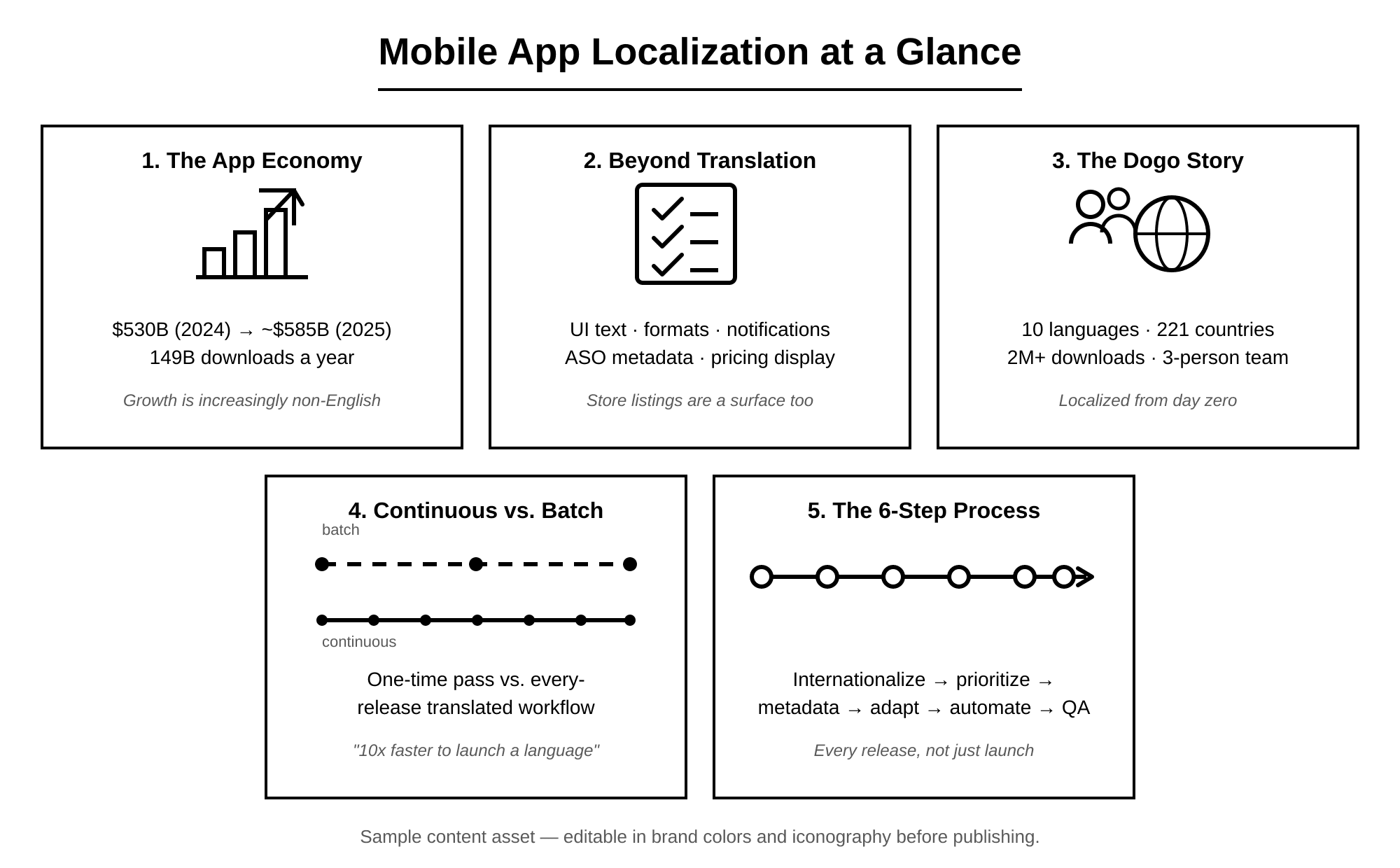
Mobile App Localization at a Glance
Mobile app localization pays off fastest when it's treated as part of the release process, not a one-time project bolted on before an international launch. Imagine localizing the app into 15 languages before launch. Subsequently, the app undergoes multiple upgrades in the next 6 months. None of those upgrades get localized into the same 15 languages. A person using the app in French, will either notice a mix of English and French, or he/she will not see the updates at all i.e. English app is the latest version while it's French version is obsolete.
Frequently Asked Questions
Translation converts text. Localization adapts UI text, formats, app store metadata, notifications, and sometimes features to fit a specific market - translation is one part of it, not the whole process.
Yes. Store listings are often the first, and sometimes only, localized touchpoint a potential user sees before deciding whether to download - treating it as a separate, priority task usually pays off faster than in-app translation alone.
For a country like India, if an Indian app is developed for the domestic market, ideally a minimum of 10 languages are needed, and if a pan-India coverage is needed, about 13 languages are ideal. For the global market, any global app should cover all standard European languages, alongwith the 11 standard Indian languages (realizing the fact that India is a major market). Generally speaking, the developer's budget can be a constraint.
Internationalization - making the codebase capable of holding multiple languages - should happen during the development process. Full localization into specific languages can follow, but retrofitting internationalization after launch is significantly more expensive than incorporating it from the start.
This is a technical process, and is directly related to software localization. It may cost 25-50% higher than any standard translation, due to slower output.
Ready for a Precise Quote?
Tell us your languages and content type, and we'll scope the right approach for your budget and timeline.