SaaS Marketing Localization: Website, Pages and Campaigns
Most SaaS companies find their localization gap in their own analytics - sign-ups from a market, few paying customers from it. See what actually needs localizing, with real examples from Canva, Slack, and Dropbox.
Most SaaS companies find their localization problem sitting inside their own analytics dashboard: a meaningful share of sign-ups come from outside the home market, but a much smaller share of paying customers do. Cleverbridge's 2025 Friction Report found 83% of SaaS companies want global expansion, but only 56% feel ready, and CSA Research has long found that 40% of consumers simply won't buy from a website that isn't in their language. This guide covers what SaaS marketing localization actually needs to cover across the website, individual landing pages, and campaigns - not just a translated homepage - and what real companies like Canva, Slack, and Dropbox have done differently.
The gap runs deeper than expansion appetite: Cleverbridge’s report also found that the companies it calls "Global Growth Leaders" are 2.5x more likely to localize every checkout touchpoint, and 2.5x more likely to report high confidence in scaling globally - localization tracking directly with readiness, not just correlating with it. (Cleverbridge, "The Friction Report: What’s Slowing Down Global Software Sales," released 15 October 2025 in partnership with Ascend2, surveying 715 software sellers and 1,081 buyers; CSA Research’s long-running "Can’t Read, Won’t Buy" findings on language and purchase behavior are cited widely across the localization industry.)
What Counts as "SaaS Marketing Localization," and Where It Initiates?
SaaS marketing localization means adapting the website, individual landing pages, in-app messaging, and campaign content - ads, email, social - for a specific market's language, currency, and buying behavior, not translating the homepage and calling the job done. The clearest diagnostic most teams already have is the gap between where sign-ups and paying customers come from - a country generating plenty of trial sign-ups but few conversions is usually a localization gap, not a product-market-fit problem.
The Website Layer: More Than a Language Switcher
A language switcher changes the words on the page; a localized website also changes currency display, date formats, trust signals, and the keywords the page is actually built to rank for in that market’s search engine. Canva offers a useful example of building this into the workflow rather than bolting it on afterward: its localization team reviews new design work through a "Localization LGTM" sign-off step embedded directly in product design docs, and an internal "i18n Slackbot" notifies the team the moment an engineer commits new user-facing text - catching localization issues before they ship, rather than later on. The company now operates across 190 countries in more than 100 languages. (Canva Localization team, "The role of localization quality in driving Canva’s exponential international growth," Canva’s Medium publication.)
Landing Pages: Why One Global Template Underperforms
A landing page translated word-for-word from the English original rarely converts as well as one rebuilt with local proof points, currency-accurate pricing, and the specific objections a buyer in that market actually has. Dropbox’s own localization history illustrates a useful sequencing lesson here: the company didn’t localize speculatively - it expanded language support in 2011 only once international users already represented an estimated 30-40% of its user base, following demonstrated demand rather than guessing at it. (ChenLi Wang, who led Dropbox’s international growth, interviewed by Reforge, "Dropbox’s Playbook for International Expansion.")
Campaigns: Ads, Email, and the Localization-vs-Translation Gap
Paid ads, lifecycle email, and social copy generally need transcreation rather than translation - tone, CTA phrasing, imagery, and even the specific payment methods get mentioned all shift by market, not just the words. Running multilingual campaigns at any real scale needs an operating structure behind it, not ad hoc translation requests. Slack's Director of Localization, Anca Greve, has described exactly that kind of structure internally:
There's three pillars in the Slack l10n team structure: projects, quality, and technology.
A Practical Process for Localizing SaaS Marketing
- Find the sign-up-to-paying-customer gap by country in your own analytics before choosing which markets to localize.
- Localize the website's core conversion path first - pricing, currency, trust signals - before blog or content localization.
- Rebuild landing pages with local proof points and objections, not a word-for-word translation of the English template.
- Transcreate campaign copy - ads, email, social - for tone and cultural fit rather than literal translation.
- Build a real localization workflow into the marketing team (a review step, a glossary, a point person) instead of routing requests ad hoc.
- Track conversion and revenue by market, not just traffic, to see where localization is actually paying off.
SaaS Marketing Localization at a Glance
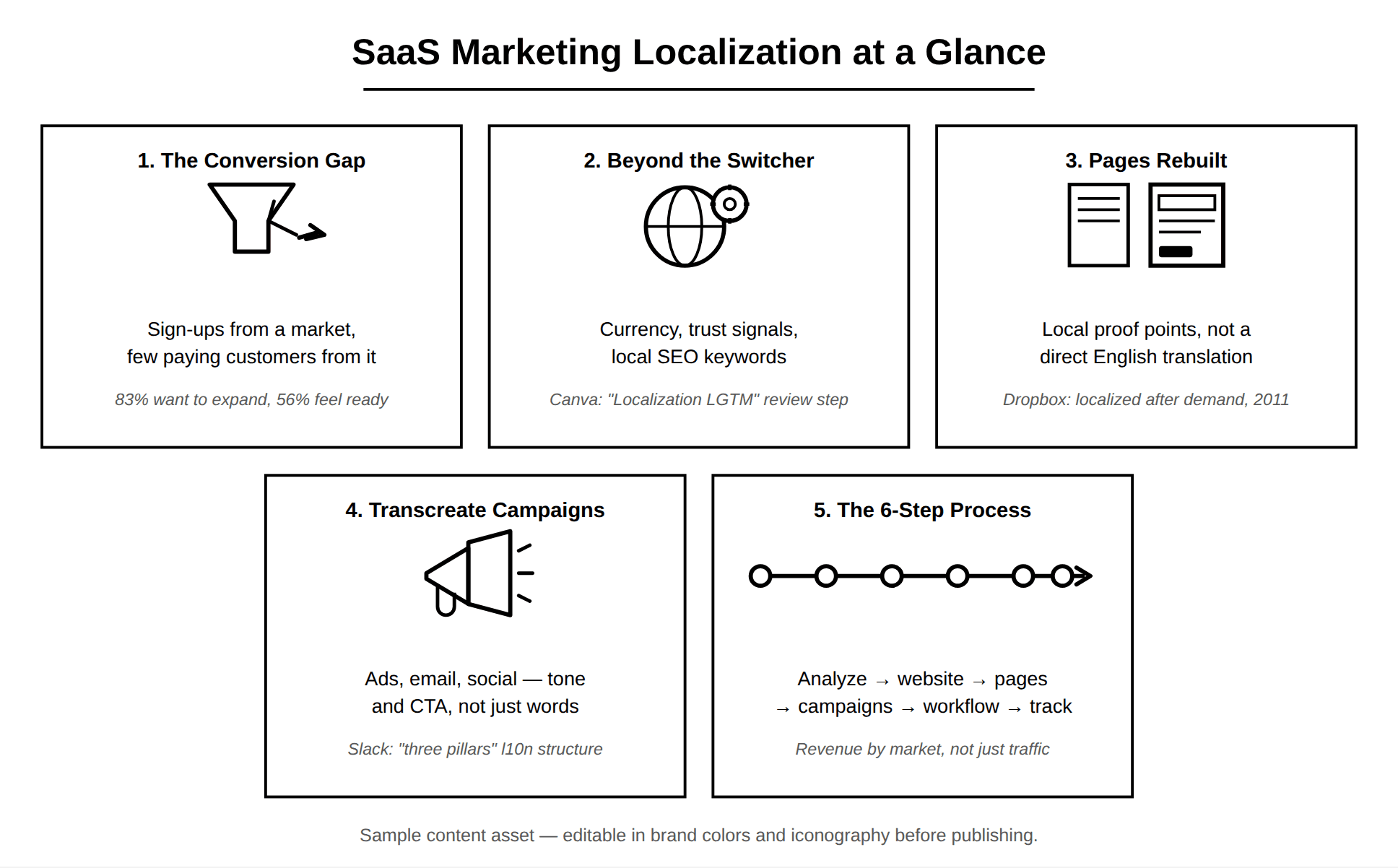
SaaS marketing localization pays off fastest when it starts where the data already points - the markets sending sign-ups that never convert.
Frequently Asked Questions
Start with the core conversion path - pricing, sign-up, and the highest-traffic landing pages - since that's where localization has the most direct revenue impact, then expand to blog and long-tail content.
Both. Currency display, local payment methods, and regionally appropriate pricing presentation are part of localization, and skipping them undercuts the value of translating the surrounding text.
Use your own sign-up and revenue data by country rather than assumptions - the countries generating meaningful sign-up volume, but low conversion, are usually the clearest localization opportunity.
Of course, transcreated. A literal translation of an English CTA or offer often loses the persuasive intent that made it work in the source market; transcreation adapts the message to land the same way for a new audience.
Ready for a Precise Quote?
Tell us your languages and content type, and we'll scope the right approach for your budget and timeline.